
Social Media
15 Social Media Management Myths That Are Hurting Your Brand


Sports organizations have never had more opportunities to reach, engage, and connect with fans. Between streaming platforms, localized social media channels, sports betting apps, gaming ecosystems, creator-led content, and the ubiquitous second-screen experience, fans are engaging with sports across more touchpoints than ever before.
But this abundance of connection points exposes a critical flaw in traditional marketing strategies. From leagues and teams to broadcasters and brand sponsors, the leaders in sports today understand that capturing attention is only the beginning. The real challenge begins once fans start engaging.
Sports fans don’t just consume content, they create culture. They celebrate victories, debate controversial calls, react to breaking news, share highlights, influence purchasing decisions, and shape brand perception in real time. Sports are woven into the fabric of their everyday lives, creating communities that extend far beyond the stadium, arena, or broadcast.
Because of this passion, attracting attention isn’t difficult. Global sports ad spend continues to break records, audiences are more connected than ever, and the volume of content competing for fan attention is staggering. The emotional reactions that drive engagement already exist. But attention alone doesn’t create loyalty, advocacy, or meaningful fan relationships.

Every post, livestream, sponsorship activation, and major sporting moment creates thousands, or even millions, of interactions. Questions need answers. Communities need moderation. Brand risks need monitoring. Conversations need engagement. Fans expect real-time responses wherever they choose to interact.
As the 2026 FIFA World Cup kicks off across the United States, Canada, and Mexico, brands and sports organizations will have access to one of the largest global audiences in history. But with that opportunity comes responsibility. Every moment of excitement, celebration, disappointment, and debate will generate engagement that must be managed at scale.
The challenge isn’t finding sports fans. It’s managing the engagement that comes after.
The old marketing funnel assumes a fan watches a game, sees an ad, and undergoes a predictable sequence of awareness to purchase. But as recent research from Eyeota highlights, “Sports fandom doesn’t sit neatly inside a stadium or a rigid broadcast window. It spills fluidly across screens, time zones, and behavioral patterns.”
Fan engagement is an always-on, non-linear ecosystem:
During a single live broadcast, a fan doesn’t just look at the television. They move between live broadcasts, streaming apps, social platforms, group chats, brand channels, and news outlets. Data shows that well over half of sports fans default to using a second screen while watching live sports.
The result? Sports marketing is no longer a static campaign. It is an ongoing, real-time conversation that impacts the entire online ecosystem.
The sports fan journey is the ongoing cycle of engagement that begins before an event, intensifies during live moments, and continues afterward through social conversations, content consumption, community participation, merchandise purchases, and brand interactions. Rather than following a linear path, fans move across multiple platforms and touchpoints throughout the year.
Attention is often viewed as the ultimate goal of sports marketing. But in reality, it’s the beginning of a much larger operational challenge.
A successful live moment instantly creates a massive influx of:
The moments generating the highest spikes in engagement require the most strict operational oversight. If you leave your digital front door unmonitored during peak traffic, you risk letting a toxic comment section hijack your multi-million dollar campaign.

As Social Factor’s Kate Grigal recently noted when discussing large-scale livestream moderation, “Brands invest heavily in creating experiences, but often underestimate what it takes to protect them. Our job is to protect it.”
That’s particularly important in sports, where emotions run high, and conversations move fast.
Social media moderation is vital during live events because sudden spikes in audience attention drastically increase brand safety risks, spam, and volatile user interactions. With the mix of real-time human moderation and AI, brands can ensure that community guidelines are enforced instantly, customer service inquiries are answered immediately, and toxic content is mitigated before it can derail a brand’s expensive live activation or campaign.
In a live environment, successful brands don’t simply publish a pre-scheduled content calendar and walk away. There is no such thing as “set it and forget it” when thousands of fans are actively reacting in your comment sections. In order for brands to be successful, it requires active live event management.
Comprehensive real-time support demands a unified approach to:
Sports fans expect immediate responses because sports happen in real time. The landscape can shift instantly; a team or athlete regarded as the absolute best in the world can be completely knocked out the very next day.
Take the FIFA World Cup as a prime example. Global powerhouses can unexpectedly collapse in the opening group stages, just as Germany did in 2022. In a matter of two weeks, they shifted from one of the most feared teams on earth to a historic disappointment.
Brands that can react to these sudden narrative shifts with operational agility gain immense cultural credibility. Brands that lack the infrastructure to pivot fail to capitalize on the moment or, worse, leave tone-deaf, pre-scheduled automated posts running that alienate their audience. Every day, minute, and second in sports carries weight. The biggest marketing opportunities and the biggest operational risks appear entirely unannounced.
“AI is excellent for triage and helping us scale workflows, but it does not replace common sense, context, or regional nuance. If you leave crisis monitoring or risk mitigation exclusively to automation, you miss the human essence of what makes social interaction valuable.”
— Kate Grigal, VP of Strategic Partnerships and Solutions, Social Factor
Many sports organizations over-index on acquiring temporary attention through paid media or flashy stunts. Far fewer invest in building and nurturing a lasting online community.
The structural difference between the two is profound: Attention is temporary, but community compounds. A viral post may generate engagement for a day. A thriving community can generate engagement for years.
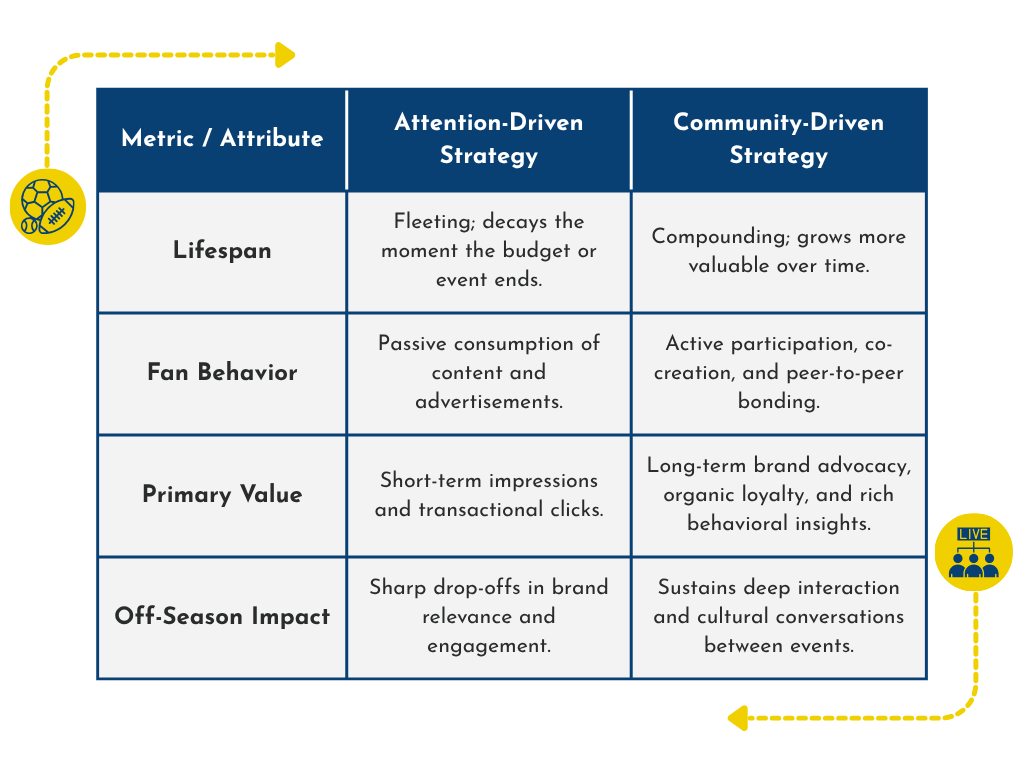
The best sports brands don’t view fans as a static audience to be spoken to. They treat them as participants and build digital spaces where they actively want to show up. When you build a structured community, you create an environment that births its own subcultures, memes, and brand loyalty.
This is particularly important as sports audiences become increasingly fragmented across platforms. Fans may engage differently on TikTok, Instagram, YouTube, Reddit, Discord, and emerging channels. Building community requires understanding those unique behaviors and creating environments where participation feels authentic.
Sports brands build online communities by shifting from a one-way broadcasting model to a two-way interactive model. This is achieved by creating dedicated, human-moderated spaces (such as branded social channels, specialized livestreams, or dark social platforms like Discord) where fans are incentivized to participate in real-time discussions, co-create culture, access exclusive merchandise, and connect directly with the athletes and teams they love.
To triumph during massive cultural milestones like the upcoming 2026 FIFA World Cup, your operational playbook must stretch far beyond a color-coded spreadsheet of pre-made graphics.
You need an integrated infrastructure built around five core pillars:
As we learned from executing massive multi-stream operations for global events like Coachella, where up to nine simultaneous live chats had to be kept safe, interactive, and commercially viable across multiple languages, the experience is only seamless for the viewer because it is rigorously managed behind the scenes.
The brands that consistently win in sports aren’t just luckier or more creative. They are operationally prepared long before the stadium lights turn on.
Sports marketers are entirely right to obsess over capturing fan attention. It is the vital spark that ignites any successful campaign. But attention is merely the starting line, not the checkered flag.
The true, measurable marketing opportunity begins the exact moment fans choose to engage with your brand. Those that intentionally invest in a foundation of proactive community management, human-led moderation, strict governance, and agile live event strategies will convert brief windows of internet attention into lifelong customer relationships.
In today’s fast-moving, multi-screen sports landscape, winning the fan’s initial attention is only half the game. Winning the conversation that follows is how you secure the victory.
Planning a live sporting event, livestream, or fan engagement campaign? Social Factor helps brands and organizations manage conversations, moderate communities, and engage audiences at scale. Contact us to learn more.

15 Social Media Management Myths That Are Hurting Your Brand

How Social Listening Predicts Crises Before They Happen

From Attention to Engagement: The Sports Marketing Playbook

AI in Social Media Marketing: Scaling Engagement Without Losing Authenticity
How Reddit’s API Changes Are Reshaping Social Listening

How Coachella 2026 Turned the Internet Into the Front Row
Social Media Engagement in 2026: What the Data Reveals
Moderation: The Critical Blindspot in Live Online Events

Future-Proofing Your Social Strategy in 2026: AI, Trends, and the Return of Judgment

Community Management Best Practices for Global Brands Managing Millions of Fans